190 Valentine’s Day Coloring Pages – KDP
For creators building on Amazon KDP—especially those publishing seasonal children’s activity books—190 Valentine’s Day Coloring Pages – KDP is more than a collection of line art. It’s a time-tested, production-ready interior asset designed to reduce friction in book creation while supporting creative consistency and market relevance.
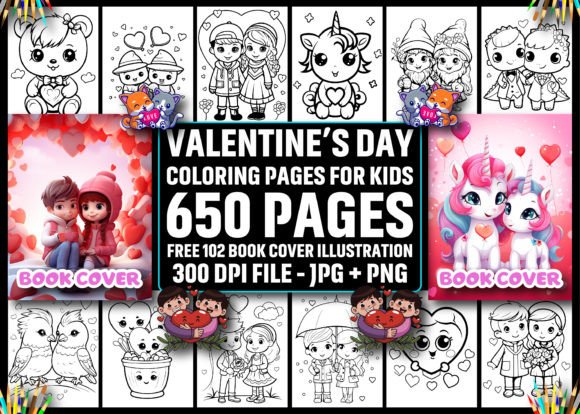
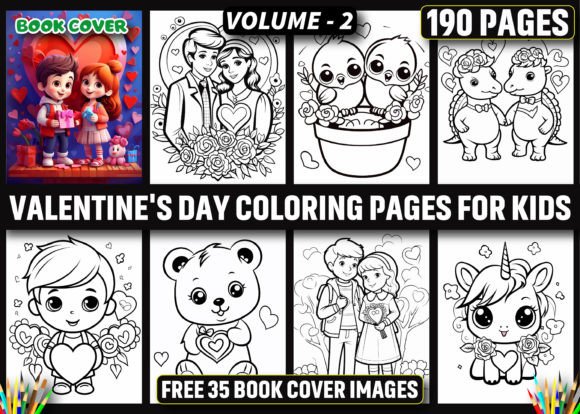
This set delivers 190 high-resolution (300 DPI), black-and-white coloring pages in both JPG and PNG formats—optimized for print clarity and digital flexibility. Unlike generic clipart bundles, every illustration is curated with young colorists in mind: balanced line weight, age-appropriate detail levels, and thematic cohesion centered on love, kindness, friendship, and gentle celebration—not romance alone. You’ll find cupids with soft expressions, heart-shaped animals, friendship-themed scenes (like kids holding hands or sharing cards), floral borders, and playful patterns—all intentionally drawn to avoid cultural or gendered assumptions.
Why This Set Fits Real Publishing Workflows
Most KDP publishers juggle design, formatting, metadata, and marketing—often without dedicated illustrators or layout specialists. With 190 Valentine’s Day Coloring Pages – KDP, you skip the early-stage bottlenecks: no commissioning delays, no licensing back-and-forth, and no guesswork about print-safe margins or bleed requirements. Each page is pre-sized to standard US letter (8.5" × 11") and includes generous white space around the artwork—critical for home printers and commercial binders alike.
Because the files are delivered as individual JPG/PNGs—not a single PDF—you retain full control over sequencing, grouping, and pacing. Need six distinct interiors? You can easily rotate themes: one volume focused on animals, another on greetings and cards, a third on nature-inspired hearts. That flexibility supports A/B testing on Amazon: different cover copy paired with subtly varied interior flows can help isolate what resonates with your audience.
Who Benefits Most—and How
Educators and homeschoolers use these pages not just for fun, but as low-pressure tools for fine motor development, emotional vocabulary building (e.g., “What does ‘kind’ look like?”), and social-emotional learning prompts. One teacher we spoke with prints select pages as part of February “Friendship Circles,” pairing coloring with short discussions about inclusion and empathy.
Freelance designers and small studios appreciate how cleanly these assets integrate into Canva, Affinity Publisher, or Adobe InDesign. Since all images are 300 DPI and background-free (PNG transparency included), dropping them into multi-page layouts takes seconds—not hours. No need to trace, clean up, or reformat scanned sketches.
Self-publishing entrepreneurs value the bundled bonus: 35 premium book cover illustrations. These aren’t afterthoughts—they’re professionally composed, layered assets (with editable text placeholders) that match the interior’s visual tone. That means your cover doesn’t just “go with” the inside—it feels like part of the same thoughtful package.
A Note on Age Appropriateness and Design Intent
While marketed for kids, the complexity level varies intentionally across the 190 pages. Early pages feature bold outlines and open shapes ideal for ages 4–6; later spreads introduce gentle textures, repeating motifs, and layered compositions suited for ages 7–10. This progression isn’t accidental—it reflects research-backed scaffolding: children build confidence when challenge increases gradually, not abruptly. If you’re targeting preschool audiences specifically, you’ll want to curate carefully—but that curation is *your* choice, not a limitation baked into the product.
Practical Considerations Before You Begin
This set works best when aligned with clear goals. If you’re launching a single, themed coloring book, it’s a strong foundation. But if you plan to mix Valentine’s content with other holidays in one volume—or need custom illustrations tied to a specific character or brand—you’ll still need supplemental work. The pages are royalty-free for commercial use *within your published books*, but they’re not customizable beyond cropping, resizing, or basic layer adjustments. You can’t edit line thickness or rearrange elements within an image.
Also worth noting: while the ZIP contains 190 unique illustrations, some share visual families—like three variations of a hedgehog holding a heart, or four iterations of a mailbox overflowing with valentines. That repetition isn’t redundancy; it’s intentional variety for readers who enjoy spotting subtle differences. But if your goal is maximum visual uniqueness per page, scan the preview thumbnails before finalizing your interior sequence.
How to Maximize Value Beyond the First Book
Many users report repurposing these pages across multiple formats—not just standalone coloring books. For example:
- Classroom printables: Isolate single pages for lesson plans or quiet-time activities—no need to reformat.
- Supplemental activity kits: Bundle select pages with simple instructions (“Draw your own valentine!” or “Color and cut out to make a card”) and sell digitally via Gumroad or Payhip.
- Social media engagement: Share one free page weekly in February using consistent branding—building email lists or Instagram followers organically.
- Hybrid physical+digital products: Include a QR code on the last page linking to a downloadable bonus pack (e.g., “Valentine’s Word Search + 5 Extra Coloring Pages”).
Because the files are high-DPI and format-flexible, none of these adaptations require new licenses or approvals. You’re not locked into one output path.
Final Thought: Quality That Scales Quietly
What makes 190 Valentine’s Day Coloring Pages – KDP stand out isn’t novelty—it’s reliability. In a niche where many bundles sacrifice line clarity for quantity, or lean too heavily on clichés (think oversimplified cartoon hearts), this set maintains artistic integrity without overcomplicating usability. It respects the child’s developing eye *and* the creator’s need for efficiency.
That balance matters most when you’re iterating quickly—whether launching your third seasonal book or supporting a school’s annual arts week. You’re not buying pixels. You’re buying workflow resilience, thematic coherence, and the quiet confidence that comes from knowing your interior won’t pixelate at print, won’t confuse young colorists, and won’t require last-minute redesigns.
If your goal is to publish thoughtfully—not just quickly—this set earns its place in your creative toolkit.