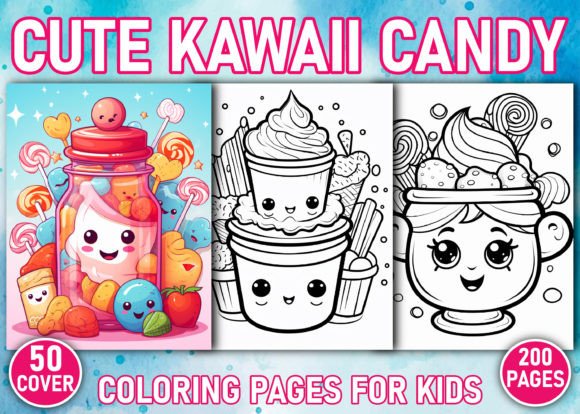
Cute Kawaii Candy Coloring Pages for KDP
For creators building scalable, low-overhead digital product lines on Amazon KDP, Cute Kawaii Candy Coloring Pages for KDP represents more than a themed asset bundle—it’s a strategic entry point into a high-demand, evergreen niche. Unlike trend-dependent categories, children’s coloring books consistently rank among the top-performing KDP segments, with kawaii aesthetics driving strong engagement across age groups, genders, and international markets. This isn’t about chasing whimsy; it’s about leveraging visual consistency, emotional resonance, and production efficiency to reduce time-to-market while increasing perceived value.
Why This Niche Delivers Measurable Strategic Value
Kawaii design—characterized by soft shapes, oversized eyes, gentle expressions, and candy-inspired motifs—functions as a cross-cultural shorthand for comfort, safety, and playfulness. That emotional signaling matters in product positioning: parents purchasing coloring books aren’t just buying line art—they’re buying calm, focus, screen-free engagement, and creative scaffolding for early development. When you deploy Cute Kawaii Candy Coloring Pages for KDP, you’re aligning with those unspoken purchase drivers—not just filling a category slot.
From an operational standpoint, the 200-page interior set (with both PDF and high-res JPG/PNG files) eliminates months of illustration work. But the real leverage lies in flexibility: editable PNGs let you rebrand, resize, or repurpose pages across formats—think activity packs, classroom handouts, subscription add-ons, or even printable party kits. That modularity supports long-term asset reuse far beyond a single KDP listing.
Strategic Positioning: Beyond “Just Another Coloring Book”
Most KDP coloring books fail not from poor art, but from weak differentiation. A title like 200 Cute Kawaii Candy Coloring Pages For Kids Vol-4 works only when paired with intentional framing. Ask yourself: Who is this *for*, and what problem does it solve *for them*?
- Educators need pages that support fine motor development and emotional regulation—so highlight thick outlines, generous spacing, and repeatable patterns that build confidence.
- Parents of neurodivergent children respond to predictable structure and sensory-friendly layouts—so emphasize consistent sizing, minimal visual clutter, and clear boundaries in your description and cover design.
- Resellers and bundlers look for clean, licensable assets—so the inclusion of 50 premium cover images isn’t just a bonus; it’s a signal of professionalism and scalability.
That means your marketing copy, cover thumbnails, and even interior page numbering should reflect purpose—not just prettiness. A strategically deployed Cute Kawaii Candy Coloring Pages for KDP asset set becomes a foundation for audience-specific messaging, not a generic filler.
Practical Integration: How to Use It With Intention
Don’t treat the 200 pages as a static inventory. Treat them as modular components. Here’s how seasoned KDP creators apply them deliberately:
- Test before you scale. Launch one 30-page mini-book using 15–20 of the strongest candy-themed pages (e.g., lollipops, cupcakes, gummy bears). Run it at $2.99 for two weeks. Monitor conversion rate, page-turning behavior (via KDP reports), and early reviews. If engagement holds, expand into the full 200-page version—or pivot to themed spin-offs (e.g., “Kawaii Candy Landscapes” or “Candy Friends & Feelings”).
- Leverage the 50 cover images intelligently. Don’t use all 50 on one book. Instead, assign distinct covers to distinct audiences: pastel tones for preschoolers, bolder contrast for older kids, minimalist versions for educators. Each cover becomes a data point in your A/B testing loop—not just decoration.
- Repurpose interiors across channels. The same PNG files can generate Instagram story templates (“Color this cupcake with us!”), printable reward charts for teachers, or even SVG cut files for Cricut users. That extends ROI beyond Amazon—and builds brand recognition off-platform.
Risks of Using Cute Kawaii Candy Coloring Pages for KDP Without Strategy
Without clear goals, even high-quality assets can backfire. Common pitfalls include:
- Over-saturation without differentiation. Publishing multiple candy-themed books with near-identical covers and titles triggers Amazon’s duplicate content filters—and confuses buyers. One well-positioned book outperforms five indistinct ones.
- Ignooring print specifications. The set includes bleed-ready A4 and 8.5″ x 11″ files—but if you skip preflight checks (margins, font embedding, image resolution), you’ll face rejected proofs or blurry interiors. Always validate one physical proof before scaling.
- Misaligning file types with use cases. Using JPGs for editable marketing assets wastes the included PNGs. Conversely, using unflattened PNGs with transparency in KDP interiors may cause unexpected white borders. Match format to function.
These aren’t technical oversights—they’re strategic missteps. They reveal unclear objectives: Are you building a brand? Testing demand? Generating supplemental income? Your answer determines how you deploy each file type, how many covers you launch, and whether you treat this as a one-off or a system.
Long-Term Asset Thinking: From Single Book to Sustainable Line
The highest-performing KDP creators view Cute Kawaii Candy Coloring Pages for KDP not as a finished product, but as a seed library. Volume 4 isn’t an endpoint—it’s evidence of repeatable workflow, audience trust, and visual continuity. That opens doors:
You can introduce companion products: a “Kawaii Candy Sticker Pack” using cropped elements from the same illustrations, or a “Candy Emotions Workbook” pairing coloring pages with simple reflection prompts. Because the style is cohesive and files are editable, these extensions require minimal new art investment—just thoughtful pedagogy and user-centered design.
Even better: track which candy motifs get the most engagement (e.g., donuts over gumdrops in early reviews), then feed those insights into Volume 5’s concepting phase. That closes the loop between data, creativity, and iteration—turning passive consumption into active learning about your audience.
What to Consider Before You Begin
Before importing any page into KDP or editing a cover, ask three questions:
- Does this page serve a specific developmental or emotional need? If it’s just “cute,” pause. Reframe it: Is it building pattern recognition? Encouraging narrative play? Supporting bilateral coordination? Anchor each decision in outcome—not aesthetics alone.
- Is the file optimized for its intended output? A 300 DPI PNG is ideal for print—but overkill for web previews. A flattened PDF ensures KDP compatibility; layered PSDs do not. Match specs to destination.
- Can I explain—clearly and concisely—why this belongs in *this* customer’s cart *today*? If your answer relies on “it’s adorable” or “there’s nothing else like it,” refine your positioning. Clarity precedes conversion.
When used with that level of intention, Cute Kawaii Candy Coloring Pages for KDP stops being a commodity and becomes a lever—a way to reduce friction in creation, increase relevance in messaging, and deepen connection with buyers who value both joy and utility.
Final Thought: Design With Discipline, Not Just Delight
Kawaii candy themes succeed because they balance familiarity and novelty—but their commercial longevity depends on disciplined execution. Every page you select, every cover you test, every extension you build should reinforce a coherent promise: that coloring isn’t just downtime—it’s quiet skill-building, emotional grounding, and shared imagination. That’s the strategy behind the sweetness. And that’s how Cute Kawaii Candy Coloring Pages for KDP moves beyond trend into trusted tool.