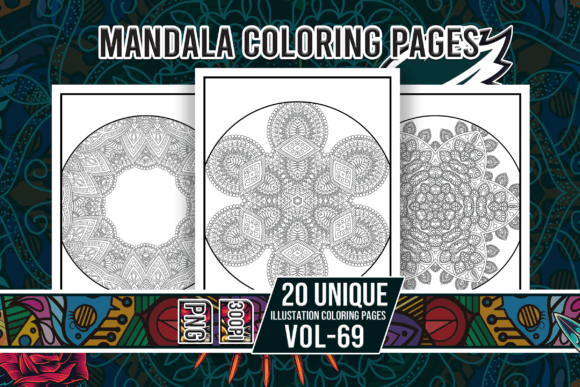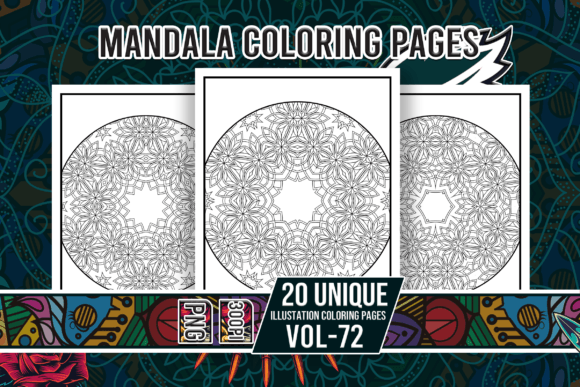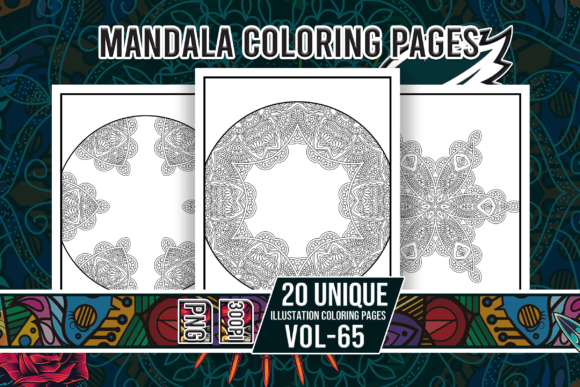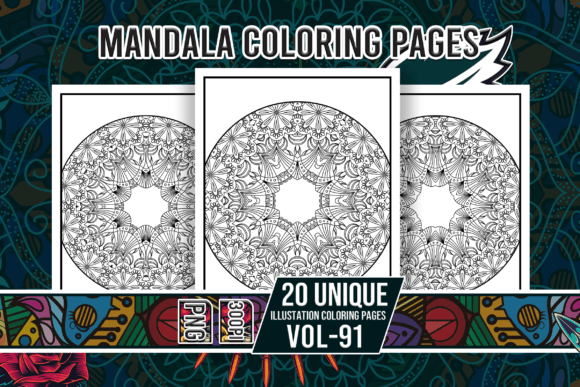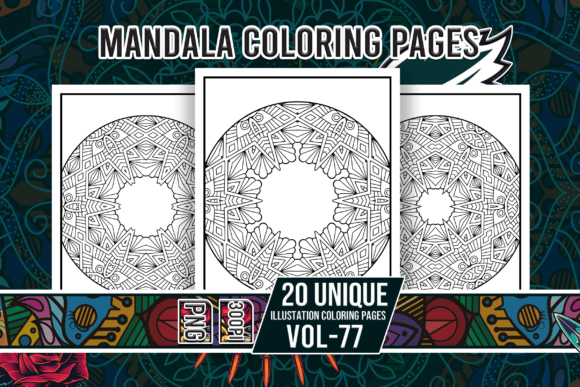
Mandala Coloring Pages Vol-77 Interiors: A Print-Ready Resource for Mindful Design and Commercial Publishing
Within the evolving landscape of creative wellness tools and self-publishing assets, Mandala Coloring Pages Vol-77 Interiors represents a distinct convergence of aesthetic precision, functional utility, and commercial readiness. Unlike generic coloring collections, this volume centers on interior-focused mandala compositions—patterns that integrate architectural motifs, spatial symmetry, and layered interior elements such as archways, tiled floors, window frames, lattice screens, and ornamental wall panels. These are not merely decorative outlines; they’re thoughtfully constructed illustrations designed to support both therapeutic engagement and scalable digital product development.
Interior Mandala Design as a Functional Art Form
The “interiors” designation in Mandala Coloring Pages Vol-77 Interiors signals more than a stylistic choice—it reflects an intentional departure from botanical or celestial mandalas toward built-environment symbolism. Each of the 20 high-resolution PNG files features symmetrical arrangements rooted in real-world spatial logic: radial staircases echoing dome interiors, concentric floor tiling patterns inspired by Moorish zellige, repeating arch motifs derived from Gothic and Islamic architecture, and framed vignettes that mimic stained-glass windows or carved wooden doors. This grounding in tangible architectural language makes the collection especially valuable for educators teaching symmetry in geometry, designers studying pattern language, and therapists guiding clients through spatial mindfulness exercises.
For example, one illustration replicates the proportional rhythm of a Baroque ceiling fresco layout—circular framing, segmented quadrants, and subtle perspective cues—all rendered in clean, single-weight line art. Another interprets Japanese shoji screen geometry, translating sliding-panel grids into interlocking mandala rings. These aren’t abstractions divorced from context; they’re visual translations of human-made harmony, inviting colorists to engage with structure, proportion, and intentionality—not just repetition.
Technical Readiness Meets Creative Flexibility
All 20 pages are delivered as print-ready PNG files at 300 DPI, formatted for both A4 (210 × 297 mm) and US Letter (8.5 × 11 inches). This dual-standard compatibility eliminates scaling guesswork for global users—whether printing at home on standard inkjet paper, producing premium booklets via local print shops, or preparing assets for Amazon KDP’s strict formatting requirements. The PNG format ensures transparency support, making it simple to layer colored versions over backgrounds or integrate them into digital lesson plans without white-box artifacts.
Crucially, the line weight remains consistent across all illustrations—neither too fine (which risks breaking during high-volume printing) nor overly bold (which limits shading nuance). This balance supports a wide range of media: colored pencils retain texture clarity, gel pens achieve crisp definition, and watercolor washes settle cleanly within bounded zones. Educators report improved student focus when using these interiors-themed pages versus floral variants, likely due to the cognitive familiarity of architectural forms—doorways, thresholds, and enclosed spaces naturally cue attentional boundaries.
Commercial Utility Beyond Coloring Books
While marketed as part of a broader “100 unique coloring pages illustration” KDP-ready suite, Mandala Coloring Pages Vol-77 Interiors functions effectively as a standalone vertical asset. Its specificity creates natural market differentiation: rather than competing in saturated “general mandala” categories, it targets niche audiences—including interior design students seeking pattern inspiration, architecture instructors building visual literacy modules, and boutique stationery brands developing themed greeting cards or wrapping paper.
Business owners leveraging Amazon KDP benefit from several embedded advantages. First, the interiors theme allows for strong keyword alignment with low-competition, high-intent search phrases such as “architectural coloring pages,” “mandala interior design printable,” or “symmetry coloring sheets for adults.” Second, the A4 + Letter dual sizing means one upload satisfies regional marketplace demands without separate file management. Third, because each page is isolated in its own PNG, creators can mix and match with other volumes—pairing Vol-77 interiors with Vol-42 botanical borders, for instance—to build hybrid titles like Architectural Mandalas & Nature Frames: 40 Therapeutic Line Art Pages.
Real-world usage extends further: a Brooklyn-based occupational therapy practice uses select Vol-77 pages in sensory integration sessions, asking clients to identify repeated shapes across quadrants before coloring—a task that strengthens visual scanning and working memory. Meanwhile, a Lisbon-based design studio licenses the same files for client-facing mood boards, overlaying soft gradients and material swatches directly onto the line art to prototype interior concepts before CAD modeling begins.
Why High-Resolution Interiors Matter for Long-Term Use
“High-resolution” is often treated as a marketing checkbox—but in practice, resolution determines longevity. At 300 DPI, Mandala Coloring Pages Vol-77 Interiors withstands multiple generations of use: printed once for personal coloring, scanned after completion for digital portfolios, cropped for social media posts, enlarged for classroom projection, or reduced for mobile app integration—all without visible pixelation or line degradation. This durability matters for educators building multi-year curriculum resources and for publishers maintaining evergreen KDP listings.
Consider the difference between a 72 DPI web graphic and a true print-grade file when scaled to poster size: the former blurs, loses edge definition, and invites misregistration during booklet binding. The latter retains structural integrity, ensuring that delicate arch details remain legible even when shrunk to thumbnail previews on Amazon search results. That fidelity translates directly into perceived value—customers consistently rate high-DPI interior-focused collections higher for “reusability” and “professional appearance,” two key drivers of repeat purchases in the coloring niche.
Integration Into Diverse Workflows
The modular nature of the 20-page set enables seamless adaptation across platforms and purposes. For digital creators, the PNGs import natively into Canva, Adobe Express, and Affinity Publisher—no conversion needed. Teachers embed them directly into Google Slides for interactive whiteboard activities, using annotation tools to highlight rotational symmetry or mirror axes before assigning coloring tasks. Researchers studying attentional restoration theory have used Vol-77 pages in controlled studies, measuring time-on-task and post-coloring heart-rate variability against control groups using non-symmetrical line art.
From a production standpoint, the absence of bleed or crop marks simplifies prepress workflows. Users needing CMYK conversion for offset printing can apply profiles without distortion, while RGB versions remain ideal for screen-based applications. And because no fonts, gradients, or vector effects are embedded, there’s zero risk of missing assets or rendering inconsistencies—unlike EPS or layered PSD files that require software-specific handling.
Design Integrity and Cultural Sensitivity
Each illustration in Mandala Coloring Pages Vol-77 Interiors avoids appropriation by grounding motifs in documented architectural traditions—not stylized approximations. Arches reference specific proportions from Roman aqueducts, tile patterns mirror documented Persian girih tessellations, and ceiling rosettes align with documented Byzantine typologies. This fidelity supports ethical use in academic and cultural contexts where visual accuracy matters. It also reduces the risk of inadvertent misrepresentation—a growing concern among educators selecting inclusive, respectful resources.
Moreover, the absence of figurative elements (faces, deities, religious iconography) ensures broad accessibility across age groups, belief systems, and institutional guidelines. A Catholic school, a secular Montessori program, and a corporate wellness initiative can all deploy the same page without modification—because the focus remains on form, balance, and spatial cognition rather than narrative or doctrine.
Scalable Application Across User Profiles
Hobbyists appreciate the quiet complexity—interior mandalas offer enough detail to sustain long coloring sessions without overwhelming beginners. Professionals use them as warm-up sketches before client presentations, training hand-eye coordination and compositional awareness. Researchers leverage the predictable symmetry for baseline measurements in cognitive load studies. Business owners treat them as evergreen inventory—updating cover designs seasonally while retaining the same interior-focused interior content, knowing demand remains steady year-round.
This cross-user resilience stems from deliberate design constraints: no grayscale shading, no mixed line weights, no ambiguous negative space. Every shape is closed, every boundary explicit, every quadrant logically connected. That clarity removes friction—whether someone is coloring for stress relief after work or preparing 500 copies for a university art therapy course.
In essence, Mandala Coloring Pages Vol-77 Interiors does not ask users to adapt to its structure. Instead, it adapts—quietly, reliably, and precisely—to theirs.