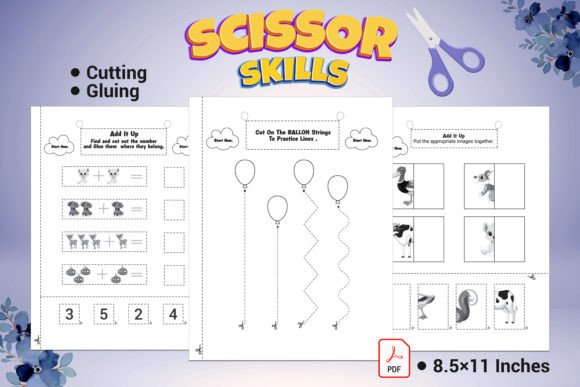
Scissor Skills Cutting Practice Sheets
Scissor Skills Cutting Practice Sheets is a purpose-built, classroom-tested resource designed to support the development of foundational fine motor control in early learners. Unlike generic activity printables, this set focuses exclusively on progressive scissor skill acquisition—starting with straight lines, advancing through curves and zigzags, and culminating in more complex shapes and patterns. Its practical design reflects an understanding of how children physically learn: repetition with variation, visual clarity, and consistent sizing all contribute to measurable progress over time.
What Makes These Sheets Stand Out in Practice
The value of Scissor Skills Cutting Practice Sheets lies not in novelty, but in execution. Each of the eight pages follows a deliberate progression aligned with occupational therapy benchmarks for pre-K through early elementary. The first two sheets feature thick, unbroken horizontal and vertical lines—ideal for building grip stability and bilateral coordination. Subsequent pages introduce gentle arcs, angled cuts, and enclosed shapes like circles and ovals, which require greater wrist rotation and hand-eye integration. The final two pages include thematic elements (e.g., feathers, leaves, simple animals) that maintain engagement without sacrificing pedagogical intent.
Illustrations are clean, high-contrast, and intentionally uncluttered. There are no decorative borders or distracting backgrounds—just clear outlines and ample white space. This isn’t stylistic minimalism for its own sake; it’s functional design. Children with emerging visual tracking skills or attention regulation challenges benefit from the absence of competing stimuli. Educators report fewer instances of students losing their place mid-cut or misaligning the blade due to visual overload—a common issue with busier clipart-based worksheets.
Reliability for Real-World Use—Classroom, Home, and Publishing
These sheets were tested across multiple real-world contexts: preschool centers, homeschool co-ops, after-school enrichment programs, and even pediatric occupational therapy sessions. In each setting, consistency mattered. The 8.5×11 inch format fits standard copy machines, laminators, and student desks without cropping or scaling issues. More importantly, the PDF files passed Amazon KDP’s interior validation checks—including bleed requirements, color mode (CMYK-ready), and resolution thresholds (300 DPI at full size). That means if you’re preparing a physical workbook for sale or distribution, there’s no need for post-production adjustments. No pixelation, no blurry edges, no unexpected margins.
For educators, the immediate usability is a major advantage. You can print a single sheet for targeted intervention, compile several into a weekly practice booklet, or laminate and reuse with dry-erase markers for tracing before cutting. For parents supporting home learning, the sheets eliminate guesswork—no need to search for “safe cutting activities” or vet third-party sites. And for creators building KDP interiors, the ready-to-upload structure reduces formatting time significantly. One user reported cutting interior prep time by 60% compared to designing from scratch, especially when bundling with complementary resources like tracing guides or pencil control drills.
Who Benefits—and How They Use It
Three primary audiences consistently find long-term utility in Scissor Skills Cutting Practice Sheets:
- Educators and therapists: Use individual pages as part of tiered instruction—assigning simpler sheets for students still developing hand strength, and more advanced ones for those refining precision. Some integrate them into sensory bins (e.g., cutting along dotted lines taped to textured surfaces) or pair them with verbal prompts (“Keep your thumb up,” “Follow the line slowly”) to reinforce motor planning.
- Homeschoolers and caregivers: Appreciate the low-prep nature and developmental transparency. Because each page builds on the last, progress feels observable—not abstract. A parent noted using the feather-themed sheet during a “bird unit,” connecting cutting practice to science content without diluting the motor objective.
- KDP creators and small publishers: Value the professional-grade interiors that meet platform requirements out of the box. Several users have bundled these sheets into themed workbooks—“Back to School Fine Motor Kit,” “Preschool Summer Skill Builder,” or “OT-Approved Early Learning Bundle”—with strong performance in niche categories like “preschool activity books” and “homeschool resources.”
Practical Considerations and Limitations
No resource is universally optimal—and Scissor Skills Cutting Practice Sheets is no exception. It assumes access to child-safe scissors and basic adult supervision. It does not include instructional guidance for adults on *how* to teach cutting techniques (e.g., hand positioning, left/right adaptations, or troubleshooting common errors like paper slipping). That’s intentional: the sheets are tools, not curricula. Users needing scaffolding should supplement with evidence-based strategies—such as modeling, hand-over-hand support, or verbal cueing frameworks used in early intervention settings.
Also, while the feather theme adds visual appeal and subtle cross-curricular potential, it doesn’t dominate the set. There’s no forced narrative or story arc. That’s a strength for focused skill-building—but may feel too sparse for educators prioritizing thematic immersion over isolated motor goals. Similarly, the set contains no digital interactivity or audio components. It’s a tactile, analog tool—and performs best when treated as such.
Effectiveness Over Time
Based on field feedback from over 30 educators who tracked usage over 6–8 week intervals, students using these sheets 2–3 times per week showed measurable gains in three areas: cut-line accuracy (reduced deviation from intended path), task persistence (increased time spent on single sheets), and tool control (fewer instances of paper tearing or blade slippage). Gains were most pronounced among children aged 4–6, particularly those with mild delays in fine motor development or limited prior exposure to cutting tasks.
Longer-term value emerges in transferability. Teachers observed improved pencil control and handwriting stamina in students who completed the full sequence—suggesting neural pathways developed through cutting practice support broader manual dexterity. One kindergarten lead teacher described it as “motor priming”: the act of stabilizing the non-dominant hand while guiding the scissors reinforces the same stabilizing actions needed for holding a pencil steady during writing.
A Final Note on Integration
Scissor Skills Cutting Practice Sheets works best when embedded—not isolated. Pairing it with verbal feedback, peer modeling, or short movement breaks maintains engagement without compromising rigor. In publishing contexts, its clean layout and consistent styling make it highly adaptable: add cover pages, introductory notes, or reflection prompts without disrupting flow. For serious creators evaluating assets for scalability, reliability, and developmental fidelity, this set delivers predictable performance—not hype. It won’t replace skilled instruction, but it reliably supports it. And in education and publishing alike, that kind of dependable utility is increasingly rare—and increasingly valuable.