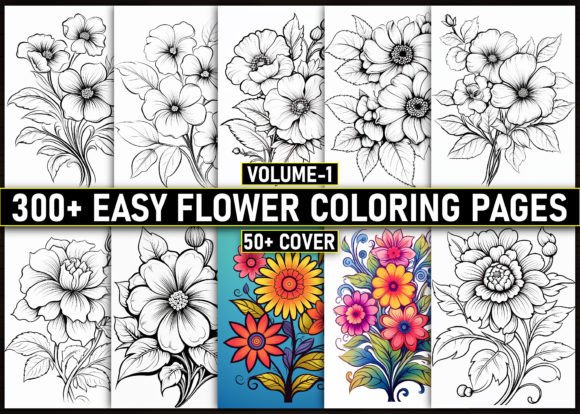
300 Easy Flower Coloring Pages for KDP: A Practical Resource for Creators, Educators, and Wellness-Focused Professionals
Coloring has evolved far beyond childhood pastime—it’s now a recognized tool for cognitive engagement, emotional regulation, and creative entrepreneurship. At the intersection of accessibility, therapeutic design, and commercial viability lies 300 Easy Flower Coloring Pages for KDP. This collection isn’t merely another set of floral outlines; it’s a deliberately structured, production-ready asset designed to serve diverse real-world needs—from classroom mindfulness activities to scalable print-on-demand publishing.
Why “Easy” Matters—Design Philosophy Behind the Collection
The term “easy” in 300 Easy Flower Coloring Pages for KDP reflects intentional design choices grounded in usability research. Each illustration avoids overly dense linework, intricate shading cues, or microscopic details that may frustrate beginners, older adults, or individuals with visual or motor sensitivities. Instead, petals are generously spaced, stems have clear directional flow, and center motifs remain open and uncluttered—supporting both fine-motor development and relaxed focus.
This approach aligns with evidence-based practices in art therapy and occupational therapy, where simplified organic forms reduce cognitive load while preserving aesthetic satisfaction. For educators working with neurodiverse learners or students recovering from attention fatigue, these pages offer low-barrier entry points into sustained creative activity—no instruction manuals or skill prerequisites required.
Production-Ready Formats: From Concept to Physical Book in One Workflow
What distinguishes this resource from generic clipart libraries is its end-to-end formatting for professional publishing. The package delivers:
- 300 PNG files—transparent-background, high-resolution (300 DPI), individually named and organized by flower type (e.g., “daisy_042.png”, “tulip_187.png”) for easy batch import into design software;
- 300 JPG files—optimized for quick preview, thumbnail generation, and lightweight digital sharing;
- One PDF interior file—A4 (8.27″ × 11.69″) and US Letter (8.5″ × 11″) compatible, with 0.125″ bleed on all sides, ready for KDP upload without layout recalibration;
- One JPG interior file—single flattened image of the full 300-page sequence, useful for mockup creation or client presentations;
- 50 premium cover images (PNG)—curated variations including minimalist line-art florals, watercolor-textured blooms, and typographic-integrated designs, all with transparent backgrounds for flexible branding.
Unlike manually assembled collections, every file maintains consistent stroke weight, alignment to baseline grids, and uniform margins—eliminating hours of manual cleanup before submission to Amazon KDP or other print platforms.
Educators and Curriculum Designers
In elementary and special education settings, floral coloring supports cross-curricular learning. A daffodil page can anchor a spring science unit on plant life cycles; a sunflower outline becomes a canvas for labeling parts of a flower; repeated petal patterns introduce symmetry and early geometry concepts. Because each of the 300 Easy Flower Coloring Pages for KDP is isolated and scalable, teachers can resize individual elements for laminated manipulatives, interactive whiteboard annotation, or tactile overlays for sensory integration activities.
Mental Wellness Practitioners
Clinical social workers, counselors, and occupational therapists increasingly integrate coloring into grounding techniques for anxiety reduction and trauma-informed care. Research published in the Art Therapy: Journal of the American Art Therapy Association notes that repetitive, predictable line work—like tracing the gentle curve of a lily petal—activates the parasympathetic nervous system more reliably than abstract or chaotic designs. The consistency across these 300 pages ensures clients encounter familiar visual rhythms, reinforcing safety and predictability during sessions.
KDP Publishers and Indie Authors
For creators building a sustainable KDP business, scalability hinges on asset reusability. These pages support multiple product lines without duplication: a single tulip illustration may appear in an adult relaxation book, a children’s botany workbook, a bilingual vocabulary builder (“flower” / “flor”), and a seasonal gratitude journal—all while retaining original resolution and licensing clarity. The inclusion of editable interiors means publishers can insert custom title pages, add guided reflection prompts, or embed QR codes linking to audio-guided meditations—without altering core assets.
Technical Considerations for Optimal Use
While the collection is designed for immediate utility, thoughtful implementation yields better outcomes. First, bleed handling: though files include 0.125″ bleed, always verify KDP’s current margin requirements before final upload—Amazon occasionally updates specifications for expanded trim options. Second, color mode: all interior files are grayscale (not RGB or CMYK), ensuring crisp black-and-white output on standard KDP paper stock. Third, scaling integrity: because each PNG is vector-derived raster (not pixel-stretched), resizing up to 120% retains edge clarity—ideal for creating oversized wall posters or classroom displays.
Importantly, the absence of copyright-restricted elements—such as trademarked floral cultivar names or photorealistic botanical renderings—means users retain full commercial rights to derivative works. You may legally add your own branding, compile subsets into themed mini-books (e.g., “Spring Bulbs: 50 Pages”), or bundle with complementary resources like printable gardening journals.
How Volume Enhances Value—Beyond the “300” Count
At first glance, “300 pages” signals quantity—but its strategic value lies in variation density. Within the set, you’ll find 42 distinct flower types, each rendered in at least five structural variations: front-facing, side-profile, bud-to-bloom progression, clustered arrangements, and single-stem isolations. This prevents visual fatigue in long-format books and allows publishers to curate thematic sequences—grouping all rose variants for a “Romantic Botanicals” edition, or selecting only wildflower species for an “Native Plants of the Midwest” series.
Moreover, the linear progression across the sequence subtly increases complexity: early pages feature broad, rounded shapes ideal for pencil control practice; later entries introduce gentle spirals (like coneflowers) and layered petal stacks (like peonies), supporting gradual skill scaffolding without abrupt difficulty spikes.
Integration With Broader Creative Ecosystems
These pages function seamlessly within common creator workflows. In Adobe InDesign, batch import scripts can auto-generate a 300-page document with automatic page numbering and alternating margin guides. In Canva, the PNGs paste cleanly into custom templates—no background removal needed. For AI-assisted enhancement, tools like Adobe Firefly or ClipDrop can intelligently upscale individual pages for large-format printing or generate complementary pattern swatches from petal motifs.
Notably, the set avoids stylistic homogeneity. Some illustrations lean into mid-century botanical simplicity; others echo Japanese sumi-e minimalism; several embrace Scandinavian flat-design sensibilities. This stylistic range lets creators match tone to audience—whimsical for kids’ books, serene for mindfulness titles, or refined for luxury stationery lines.
Long-Term Utility and Adaptability
Unlike trend-dependent assets, floral motifs demonstrate enduring relevance across cultures and generations. A daisy carries symbolic weight in poetry, medicine, and folklore—from ancient Greek associations with innocence to modern mental health campaigns using the flower as a symbol of resilience. This cultural resonance ensures longevity: a coloring book built from 300 Easy Flower Coloring Pages for KDP remains marketable year after year, adaptable to seasonal promotions (Mother’s Day bundles), educational initiatives (National Pollinator Week), or community programs (senior center wellness kits).
Further, the modular nature of the files supports iterative improvement. Publishers can test cover variants using the 50 included PNGs, track conversion rates per design, then refine future volumes based on empirical data—not guesswork. Educators can annotate individual pages with stickers or digital overlays, then archive annotated versions for curriculum revision cycles.
Final Observations: When Simplicity Serves Complexity
In a landscape saturated with hyper-detailed mandalas and maximalist illustrations, the power of simplicity is often underestimated. These 300 pages prove that restraint—clean lines, breathing space, intentional repetition—creates room for deeper engagement. Whether used to calm a restless child before a standardized test, help an adult reconnect with tactile sensation after screen fatigue, or provide a reliable foundation for a six-figure KDP catalog, their strength lies not in ornateness, but in reliability.
They don’t ask users to become artists. They invite them to pause, trace, breathe, and recognize themselves—not in perfection, but in presence. That quiet utility, multiplied across 300 thoughtful iterations, makes 300 Easy Flower Coloring Pages for KDP less of a product and more of a quietly essential infrastructure for human-centered creation.