320 Pirates Coloring Pages for Kids KDP: A Practical Evaluation for Publishers and Educators
For creators building coloring books on Amazon Kindle Direct Publishing (KDP), consistency, scalability, and production efficiency matter as much as theme appeal. The 320 Pirates Coloring Pages for Kids KDP stands out not because it’s the only pirate-themed bundle available—but because of how its structure supports real-world publishing workflows. Volume 4 of this series delivers a tightly curated, technically optimized set of assets designed specifically for high-content book production—not just casual printing or classroom use.
What Makes This Bundle Distinctive?
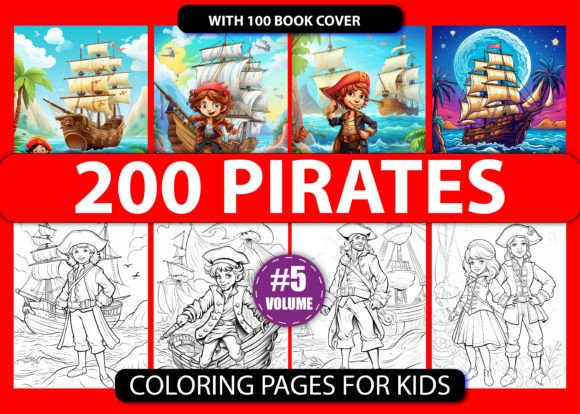
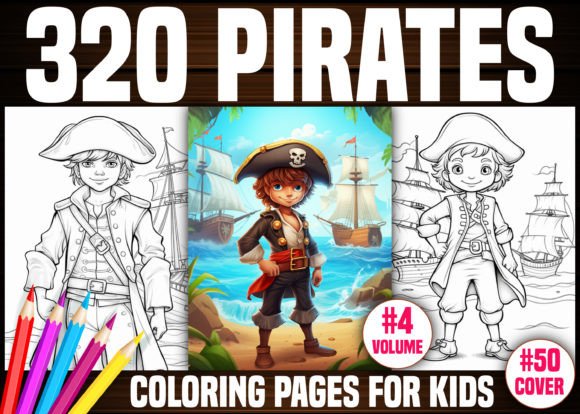
At its core, the 320 Pirates Coloring Pages for Kids KDP is a production-ready graphic asset pack—not a pre-assembled book. It includes 320 individual black-and-white line art illustrations, each rendered at 300 DPI in both JPEG and PNG formats. That dual-format inclusion matters: PNGs preserve transparent backgrounds for flexible layout work in design tools like Adobe InDesign or Affinity Publisher, while JPEGs offer lightweight compatibility for quick previews or batch processing. All files conform to the standard 8.5 x 11 inch size, eliminating scaling guesswork during interior assembly.
Unlike many generic coloring page bundles that prioritize quantity over usability, this set includes 50 unique cover designs—each professionally styled and sized to match the interior dimensions. That means you’re not forced to reuse one cover across multiple titles or rely on third-party templates that may misalign with your branding. You can build five distinct, cohesive coloring books from a single purchase—each with its own visual identity—without sourcing additional artwork.
The ready-to-print PDF interior file further reduces friction. It’s not a placeholder or demo; it’s a fully formatted, print-optimized PDF with bleed and margins aligned to KDP’s current specifications (as of mid-2024). That eliminates common formatting pitfalls—like cut-off edges or inconsistent margins—that delay publishing or trigger KDP review rejections.
How It Compares to Other Approaches
Many publishers start by commissioning custom illustrations. That offers full creative control but carries significant tradeoffs: higher upfront cost (often $2,000–$5,000+ for 300+ pages), longer timelines (8–16 weeks), and no built-in cover or formatting support. Others rely on royalty-free marketplaces (e.g., Shutterstock, Creative Market), where pirate-themed line art varies widely in quality, DPI consistency, and commercial licensing clarity—especially for KDP redistribution. Some bundles lack usable PNGs, omit cover options entirely, or include images sized for social media—not print.
The 320 Pirates Coloring Pages for Kids KDP sits between those extremes. It doesn’t replace bespoke illustration for niche branding (e.g., a historically accurate pirate series with annotated maps), nor does it compete with ultra-low-cost clipart packs that risk copyright ambiguity or pixelation when scaled. Instead, it targets creators who need dependable, publication-grade assets—fast—with clear usage rights and technical readiness.
Strengths Beyond the Obvious
One underappreciated strength is resolution fidelity. At 300 DPI, every line remains crisp even when printed on matte or uncoated paper—a frequent pain point with lower-DPI bundles that appear fuzzy or broken on physical copies. That reliability translates directly to fewer customer complaints and lower return rates, especially important for KDP sellers operating on thin margins.
Another practical advantage is thematic cohesion without monotony. While all 320 pages fall under the “pirate” umbrella, the collection spans varied subtopics: treasure maps, ship interiors, pirate animals (parrots, cats, octopuses), underwater scenes, pirate towns, and whimsical characters with diverse expressions and poses. That variety helps avoid the “sameness” readers report in some themed bundles—where every page feels like a slight variation of the same ship outline.
The black-and-white rendering is intentionally bold and clean—not overly detailed or faint—making it accessible for younger children (ages 4–8) while still offering enough structure to engage older kids (9–12) who prefer more intricate scenes. That balance expands potential audience reach compared to bundles skewed toward either preschool simplicity or advanced teen-level complexity.
Realistic Tradeoffs and Limitations
This isn’t a universal solution. If you require editable vector files (e.g., SVG or AI), the 320 Pirates Coloring Pages for Kids KDP won’t meet that need—it delivers raster images only. Vector assets allow infinite scaling and layer-based editing, which matters for designers planning extensive customization (e.g., adding text callouts, rearranging elements per page). Raster files are fixed-resolution; while 300 DPI covers most use cases, they can’t be enlarged beyond ~150% without visible degradation.
Licensing is another consideration. The bundle permits use in KDP books, printable PDFs, and physical products you manufacture—but it does not grant rights for resale as standalone digital files, use in subscription services, or integration into apps or digital coloring platforms. Those use cases require separate licensing agreements, which this package doesn’t cover.
Also, while the 50 covers provide strong variety, they follow a consistent stylistic language—bold outlines, playful typography, classic pirate motifs. That’s an asset for brand consistency but may not suit creators pursuing minimalist, vintage, or hyper-realistic aesthetics. In those cases, supplementing with custom cover design remains advisable.
When It’s the Right Fit—and When It’s Not
The 320 Pirates Coloring Pages for Kids KDP works best when you’re launching multiple themed titles quickly, testing market response across variations (e.g., “Pirate Mazes,” “Pirate Dot-to-Dot,” “Pirate Word Search”), or building a seasonal catalog (e.g., summer activity bundles). Its structure supports A/B testing of covers, pricing tiers, and subtitle phrasing—all without new art costs.
It’s also well-suited for educators or homeschoolers creating custom printable resources—since the high-resolution files print cleanly on standard home printers, and the PNGs integrate smoothly into lesson plans or interactive PDFs with fillable fields.
Conversely, if your goal is deep educational integration—say, pairing each coloring page with historical notes, vocabulary builders, or QR-linked audio—you’ll likely need to layer additional content development on top. The bundle supplies the visuals, not the pedagogical framework. Similarly, creators focused on premium hardcover editions with foil-stamped covers or specialty paper may find the included covers insufficiently refined for luxury positioning.
Making an Informed Choice
Evaluating resources like the 320 Pirates Coloring Pages for Kids KDP comes down to matching technical specs, licensing scope, and workflow needs—not just theme or count. Ask yourself: Do I need speed and consistency over total creative control? Am I prioritizing KDP compliance and print reliability? Will I publish multiple versions—or just one title?
If yes to those, this bundle reduces friction significantly. If your priority is adaptability across formats (digital apps, vectors, merch), or if you’re building a long-term branded universe requiring exclusive IP, then investing in custom illustration—or combining several specialized assets—may better serve your goals.
In short, the 320 Pirates Coloring Pages for Kids KDP doesn’t try to be everything. It excels at what it’s built for: enabling fast, professional, scalable coloring book production—without compromise on print quality or platform readiness.