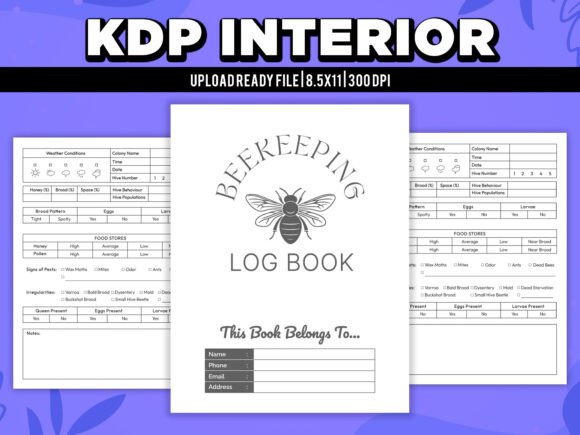
Beekeepers Record Keeping Log
A Beekeepers Record Keeping Log is a preformatted, printable PDF interior designed specifically for beekeepers to document hive inspections, colony health, weather conditions, treatments, honey yields, and seasonal management activities. This particular version measures 8.5 x 11 inches, contains 120 pages, is set at 300 dpi for crisp print quality, includes no bleed (ensuring text and grids stay fully within margins), and is optimized for commercial use—especially for publishing on Amazon Kindle Direct Publishing (KDP).
This log is not software or a digital app; it is a physical journal layout delivered as a single PDF file. Its structure follows standard beekeeping best practices: dated entry pages, consistent sections for queen status, brood pattern notes, pest observations (e.g., varroa mite counts), feeding records, and swarm prevention actions. Because it’s ready for KDP upload, it requires no additional formatting—just pairing with a compatible cover and publishing.
People consider a Beekeepers Record Keeping Log for several practical reasons. New beekeepers often struggle with consistency in tracking changes across hives, especially during their first full season. Without documentation, patterns—like recurring disease symptoms or nectar flow timing—can go unnoticed. Experienced beekeepers may seek a standardized format to simplify year-over-year comparisons or meet state apiary inspection requirements. Others use logs to support educational outreach, mentoring, or small-scale apiary certification programs where verifiable records are expected.
The primary benefit of this specific log lies in its readiness and reliability. At 120 pages, it supports approximately one full beekeeping season (spring through fall) with room for multiple hives—assuming weekly or biweekly entries. The 300 dpi resolution ensures legibility when printed, and the no-bleed design prevents critical grid lines or headers from being cut off during KDP’s printing process. Its commercial license means buyers can resell printed copies without restriction—a key consideration for educators, beekeeping associations, or small apiary supply shops looking to offer branded tools.
However, tradeoffs exist. Because it is a static PDF, users cannot edit entries digitally—no search, sorting, or auto-calculations. If someone prefers spreadsheet-based tracking (e.g., Excel or Google Sheets), this log offers less flexibility for data analysis or exporting summaries. Similarly, those who rely heavily on mobile note-taking or voice-to-text input during inspections may find paper-based logging less efficient. The fixed page count also means it’s not expandable: users needing more than 120 pages—or fewer—must either work within that constraint or seek a customizable alternative.
Another consideration is usability context. This Beekeepers Record Keeping Log assumes familiarity with common beekeeping terminology and observational methods. It does not include instructional content—no definitions of “capped brood” or “drone-laying queen,” for example. A beginner who hasn’t yet learned what to look for during an inspection may need supplemental learning resources alongside the log. Likewise, while the layout accommodates standard hive types (Langstroth, top-bar), it doesn’t provide specialized sections for niche systems like Warre or horizontal hives unless adapted manually.
This log is a strong fit for readers whose goals align with simplicity, consistency, and compliance. For instance, it suits hobbyist beekeepers managing 1–5 hives who want a durable, reusable system without investing time in designing their own template. It also fits educators preparing course materials for hands-on beekeeping workshops—where uniform record formats help students compare notes and reinforce observational discipline. Apiary inspectors or extension agents may recommend it to clients seeking a low-tech, accessible way to maintain legally sufficient records in jurisdictions requiring hive documentation.
Conversely, alternatives may be preferable in other situations. Beekeepers managing large operations (10+ hives) often benefit from digital solutions—such as dedicated apps like HiveTracks or Beekeep—because they support filtering, mapping, bulk exports, and reminders. Those integrating records with broader farm management systems (e.g., tracking honey sales alongside hive health) may prefer customizable spreadsheets or database tools. And individuals with accessibility needs—such as low vision or motor coordination challenges—may find typed or voice-assisted digital logs more usable than handwriting in a fixed-layout journal.
Practical decision-making starts with clarifying intent. Ask: What do I need the log to help me do? If the answer emphasizes ease of adoption, minimal setup, and reliable physical archiving—especially for teaching or gifting—this Beekeepers Record Keeping Log meets those aims efficiently. If the priority is integration, scalability, or real-time collaboration (e.g., shared hive updates among family members or club members), then exploring digital or modular options becomes more appropriate.
Also consider usage frequency and environment. Beekeepers working outdoors in variable weather may prefer laminated sheets or waterproof notebooks over standard paper—meaning a printable PDF log would need to be paired with durable printing stock. Conversely, those keeping records indoors after inspections may value the clean, structured layout without worrying about durability.
Finally, evaluate long-term expectations. A 120-page log covers one season well—but does the user anticipate multi-year tracking? While some keep annual volumes, others prefer consolidated digital archives. There’s no inherent limitation to reusing the same PDF year after year, but doing so requires manual organization (e.g., naming files by year) and separate storage solutions. Users expecting automatic continuity across seasons may find that expectation unmet without additional effort.
In summary, the Beekeepers Record Keeping Log serves a clear, focused purpose: providing a professionally formatted, print-ready journal for systematic hive observation and management. Its strengths—standardization, print fidelity, commercial licensing, and immediate usability—make it valuable for specific audiences and contexts. Its limitations—lack of digital interactivity, fixed length, and absence of instructional scaffolding—mean it works best when matched thoughtfully to the user’s experience level, operational scale, and record-keeping habits. Choosing whether it fits depends less on features alone and more on how those features interact with real-world workflow, learning stage, and long-term stewardship goals.
Before acquiring, review sample pages if available, confirm compatibility with your printer or KDP workflow, and assess whether supplementary resources (e.g., beekeeping guides, local extension bulletins) will support effective use. As with any record-keeping tool, consistency matters more than perfection—what counts is regular, honest observation. This log provides the structure; the insights come from the beekeeper’s attention.