Parent Contact Log Printable Sheet: A Practical Tool for Consistent, Organized Communication
Effective communication between educators, caregivers, and families lies at the heart of student support—yet it’s often inconsistent, fragmented, or lost in the shuffle of daily responsibilities. The Parent Contact Log Printable Sheet addresses this gap not with complex software or subscription services, but with a deliberately simple, printable, and highly functional document designed for real-world use. At its core, it’s a structured record-keeping system—120 pages of thoughtfully spaced, ready-to-print forms that turn sporadic notes into actionable insights.
Why Structure Matters More Than Ever
In classrooms, homeschool co-ops, tutoring centers, and even early intervention programs, contact logs serve as more than administrative paperwork. They become evidence of engagement, continuity across staff transitions, and a reference point during parent conferences or IEP meetings. Without structure, notes tend to be vague (“talked about behavior”), time-stamped inconsistently, or scattered across sticky notes, emails, and memory. The Parent Contact Log Printable Sheet imposes gentle discipline on documentation—not through rigidity, but through intentional design.
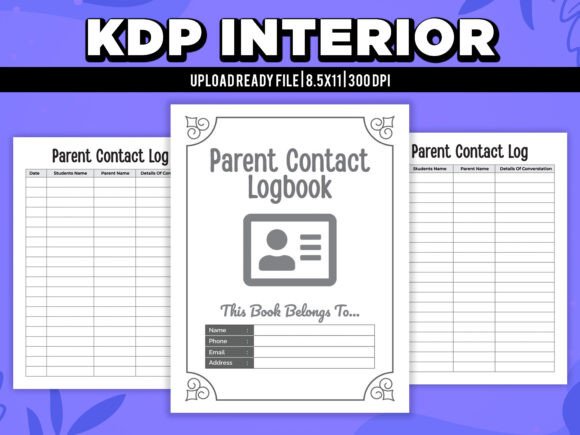
Each page features clearly labeled fields: date, time, method (phone, email, in-person, text), parent/guardian name, student name, topic discussed, key points, follow-up actions, and signature lines. This isn’t arbitrary formatting—it mirrors how educators naturally process interactions. For example, when a third-grade teacher documents a call about reading progress, the “topic” field helps her quickly scan past entries for patterns; the “follow-up actions” column ensures she doesn’t forget to email the decodable reader home by Friday.
Design Decisions That Support Real Workflows
The specifications—8.5 x 11 inch size, 300 dpi resolution, no bleed, 120-page PDF, commercial use license—aren’t just technical footnotes. They reflect deliberate choices grounded in usability research and educator feedback:
- 8.5 x 11 inch: Fits standard printers, three-ring binders, and desk organizers without cropping or resizing. No wasted margins, no scaling errors—just immediate utility.
- 300 dpi: Ensures crisp text and clean lines whether printed on budget copy paper or premium matte stock. Legibility remains high even after repeated handling or photocopying—a critical factor for busy school offices.
- No bleed: Eliminates risk of content being cut off during printing or binding. Every line, checkbox, and header stays fully visible—no guesswork, no reprints.
- 120 pages: Offers sustained use across an academic year (roughly one page per week for two students, or biweekly for a full class of 30). It avoids the frustration of running out mid-semester while preventing bulkiness that discourages consistent use.
- Commercial use license: Enables creators, curriculum designers, and small educational businesses to integrate the log into service packages, coaching materials, or bundled resources—without legal ambiguity or attribution requirements.
This level of intentionality separates the Parent Contact Log Printable Sheet from generic blank templates. It anticipates friction points: misaligned columns on low-end printers, ink bleeding through thin paper, or pages that don’t lie flat on a cluttered desk. It doesn’t assume users have access to laminators or tablet styluses—it assumes they have a printer, a pen, and five minutes between classes.
Who Benefits—and How They Use It Differently
While often associated with classroom teachers, the utility of this resource extends across diverse roles—each adapting it to their unique context:
Educators in Public and Private Schools
Classroom teachers use it to track recurring themes—like attendance concerns escalating over six weeks—or to prepare for parent-teacher conferences with concrete examples. Special education case managers rely on it during eligibility reviews, where documented communication history supports procedural compliance. One middle school counselor shared how she cross-references her log entries with behavior incident reports to identify environmental triggers—something impossible without chronological, standardized records.
Homeschooling Families and Learning Co-ops
Parents coordinating with tutors, therapists, or enrichment instructors use the log to maintain consistency across providers. A homeschool mom in Oregon noted how logging weekly check-ins with her child’s speech-language pathologist helped her spot subtle improvements in articulation timing—details she’d otherwise overlook without written benchmarks. The physical nature of the sheet also reduces screen fatigue during already tech-heavy days.
After-School Program Staff and Youth Workers
Frontline staff in community centers or mentoring programs often juggle high caseloads with limited admin support. The Parent Contact Log Printable Sheet gives them a lightweight, non-digital way to capture consent updates, transportation changes, or behavioral observations—then file them securely without needing login credentials or data privacy training.
Small Business Owners Serving Families
Tutoring studios, pediatric occupational therapy practices, and family coaching services embed the log into onboarding packets. It signals professionalism and accountability—while also serving as a subtle intake tool. When parents fill out initial contact details and topics of concern, practitioners gain immediate insight into priorities before the first session begins.
Integration Without Overhaul
One common misconception is that adopting a new documentation system requires workflow disruption. In practice, the Parent Contact Log Printable Sheet integrates seamlessly because it asks for minimal behavior change. It doesn’t require learning new software shortcuts or syncing cloud accounts. Instead, it meets users where they are:
- A kindergarten teacher keeps a bound copy on her desk and logs calls during lunch duty.
- A private tutor stores the PDF in a tablet folder and prints single pages as needed—no need to carry a full binder.
- A district office distributes printed copies to new hires alongside orientation handbooks, framing documentation as foundational—not optional.
Its portability also supports hybrid environments. During remote learning periods, educators used the log to record virtual meeting notes, tech support requests, or device distribution follow-ups—proving its adaptability beyond traditional face-to-face interaction.
Long-Term Value Beyond the First Page
The cumulative power of the Parent Contact Log Printable Sheet emerges over time. After six months, patterns surface: which families initiate contact most frequently (indicating high engagement or unmet needs), which topics recur across grade levels (suggesting systemic curriculum gaps), or how response times correlate with resolution rates. These aren’t abstract analytics—they’re observable, tangible trends derived from consistent, low-effort recording.
For researchers studying family-school partnerships, anonymized log data offers rich qualitative material—especially when paired with demographic or academic outcome metrics. For school improvement teams, aggregated logs help identify communication bottlenecks: Are certain grade levels under-documented? Do specific staff members consistently note follow-ups that never close? These insights inform professional development—not speculation.
Even from a compliance standpoint, having 120 pages of dated, signed logs provides demonstrable evidence of good faith effort in maintaining transparency—valuable during audits, accreditation reviews, or dispute resolution.
Thoughtful Licensing for Sustainable Creation
The inclusion of commercial use rights reflects an understanding of how educational resources actually circulate. Teachers don’t just consume—they adapt, bundle, and resell curated materials to peers. Curriculum developers incorporate logs into larger intervention kits. Small publishers compile themed bundles—“Back-to-School Readiness Pack” or “IEP Support Toolkit”—where the Parent Contact Log Printable Sheet serves as both a functional component and a trust signal.
This licensing model supports ethical reuse: no hidden restrictions, no mandatory attribution that clutters lesson plans, and no expiration. Creators can confidently upload the interior to Amazon KDP alongside complementary covers, knowing the file meets platform requirements—1 PDF file, print-ready, no bleed, optimized for 6” x 9” or 8.5” x 11” trim sizes. Its readiness for KDP isn’t a marketing claim; it’s baked into the production specs from the start.
When Simplicity Becomes Strategic
In an era of AI-powered dashboards and automated reporting tools, the enduring relevance of a well-designed printable sheet may seem counterintuitive. Yet its strength lies precisely in what it omits: no login screens, no update notifications, no data harvesting. It places agency entirely with the user—enabling reflection, discretion, and ownership of sensitive information.
A special education director in Wisconsin described using the log during sensitive conversations about student safety: “I don’t want those words living in an email server or cloud folder. I write them down, file the page, and know exactly where it is—physically and ethically.” That level of control isn’t a limitation; it’s a feature calibrated for human judgment and contextual nuance.
Ultimately, the Parent Contact Log Printable Sheet succeeds not by replacing technology, but by complementing it—offering stability where digital tools fluctuate, clarity where interfaces overwhelm, and quiet reliability where urgency demands focus. It’s documentation designed not for systems, but for people doing meaningful work—one thoughtful entry at a time.