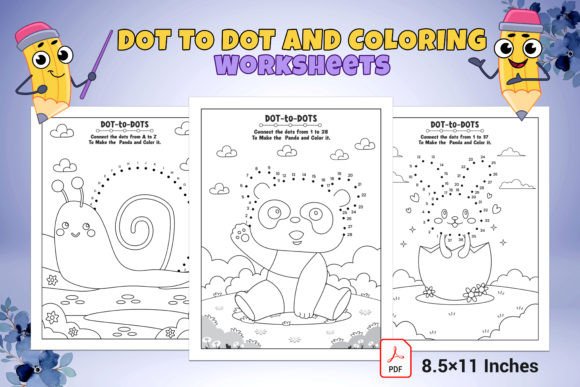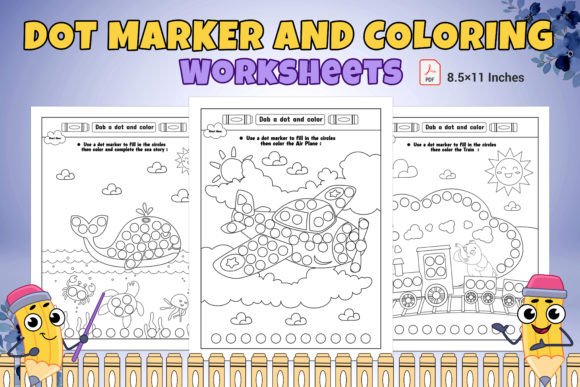
Dot Marker and Coloring Worksheets
Dot Marker and Coloring Worksheets are printable activity pages designed primarily for children aged 3 to 6. Each worksheet features outlined shapes, letters, numbers, or thematic scenes—such as animals, seasons, or vehicles—composed entirely of evenly spaced dots. Children fill in the dots using dot markers (also called bingo dabbers), crayons, stickers, or even finger painting. The result is both a coloring experience and a structured fine motor exercise.
Why Consider Dot Marker and Coloring Worksheets?
Families, educators, and self-publishers often seek resources that support early childhood development while remaining practical to implement. Dot Marker and Coloring Worksheets meet several overlapping needs: they require minimal preparation, accommodate varied learning environments (classroom, home, therapy setting), and scale easily for group use or individual practice. For those evaluating options, key motivations include supporting pre-writing readiness, reinforcing letter or number recognition, and offering screen-free engagement.
Documented Benefits for Early Learners
Research and classroom observation consistently link dot-matching activities with improvements in foundational skills:
- Fine motor development: Pressing a marker or dabber requires controlled hand strength, wrist stability, and finger isolation—prerequisites for holding a pencil correctly.
- Hand-eye coordination: Accurately placing color inside a dot boundary strengthens visual-motor integration.
- Visual discrimination: Distinguishing dot patterns within larger shapes supports later reading fluency and attention to detail.
- Color and shape recognition: Thematic designs (e.g., dinosaurs, fruits, community helpers) introduce vocabulary and categorization in context.
- Task persistence and focus: Completing a page provides tangible accomplishment, encouraging sustained attention in short, manageable segments.
These benefits are most pronounced when used consistently and with appropriate adult guidance—not as passive entertainment, but as intentional practice.
Practical Considerations and Tradeoffs
While Dot Marker and Coloring Worksheets offer clear developmental value, their effectiveness depends on implementation and alignment with goals.
Format limitations: As black-and-white PDFs intended for printing, they require access to a printer, paper, and marking tools. Families without reliable printing may find digital alternatives or reusable dry-erase versions more sustainable. Similarly, worksheets with dense dot patterns may frustrate younger children who lack sufficient finger control—simpler layouts with larger spacing are better suited for beginners.
Content scope: A set of eight themed pages offers variety but limited repetition. For skill mastery—especially letter formation or number sequencing—supplementary materials (e.g., tracing sheets, manipulatives) may be needed. Users seeking curriculum-aligned content should verify whether themes match local early learning standards (e.g., Common Core ELA foundations or state preschool guidelines).
KDP-specific considerations: For creators preparing interiors for Amazon Kindle Direct Publishing, the listed specifications—8.5″ × 11″ size, no bleed, high-resolution black-and-white interiors—are industry-standard and KDP-tested. This reduces formatting risk during upload. However, buyers intending to publish should confirm whether the file includes editable layers (it does not—it’s a flattened PDF), and whether licensing permits commercial resale or modification (standard usage typically covers personal and single-teacher classroom use unless otherwise stated).
When These Worksheets Are a Strong Fit
Dot Marker and Coloring Worksheets work well in the following scenarios:
- Preschool or kindergarten classrooms needing low-prep, small-group center activities that reinforce weekly themes (e.g., “Ocean Week” or “Alphabet A”) without requiring teacher-led instruction.
- Occupational therapy sessions where graded tasks help build grasp strength and bilateral coordination—especially when paired with verbal prompts or adaptive tools (e.g., chunky markers or weighted grips).
- At-home practice for families supporting early writing development, particularly if children respond well to colorful, tactile input and enjoy predictable routines.
- KDP interior creation for educators or designers launching a low-cost, niche activity book focused on fine motor development—provided the artwork is original or properly licensed, and the layout meets Amazon’s print requirements.
When Alternatives May Be More Appropriate
Consider other formats if any of the following apply:
- Limited access to supplies: If dot markers or ink-safe dabbers aren’t available, traditional coloring pages or tracing worksheets may be more accessible—and still support motor development, albeit with different biomechanical demands.
- Need for differentiated instruction: Children with significant motor delays may benefit more from multi-sensory tools—such as raised-line tracing boards, playdough letter mats, or magnetic letter sets—that allow manipulation beyond marking.
- Preference for reusable resources: Laminated dot marker cards or digital tablet apps with stylus support reduce paper waste and allow repeated use—valuable in budget-constrained or eco-conscious settings.
- Curriculum integration: If alignment with specific learning objectives (e.g., phonemic awareness or counting strategies) is essential, look for worksheets explicitly tied to evidence-based frameworks—rather than general thematic collections.
Making an Informed Decision
Before selecting Dot Marker and Coloring Worksheets—or any early learning resource—ask these questions:
- What specific skill am I aiming to support? If it’s pencil grip or wrist extension, dot marking is well-supported. If it’s phonics decoding, another tool may be more direct.
- Do I have the necessary materials and time for setup? Dot markers dry quickly and resist smudging, but they do require storage and occasional cleaning. Finger-painting alternatives avoid supplies but add cleanup time.
- Is the content age- and ability-appropriate? Review sample pages for dot density, line clarity, and theme relevance. Simpler outlines with generous spacing suit ages 3–4; tighter patterns suit ages 5–6.
- How will I use this long-term? For one-time classroom centers, a ready-to-print PDF works efficiently. For ongoing home use, consider durability, storage, and whether children will engage repeatedly with the same themes.
Dot Marker and Coloring Worksheets serve a distinct role in early learning: they combine structure with creativity, repetition with novelty, and skill-building with enjoyment. Their value emerges not in isolation—but as part of a broader, responsive approach to child development. When matched thoughtfully to need, context, and available resources, they remain a practical, research-informed choice for educators, caregivers, and content creators alike.