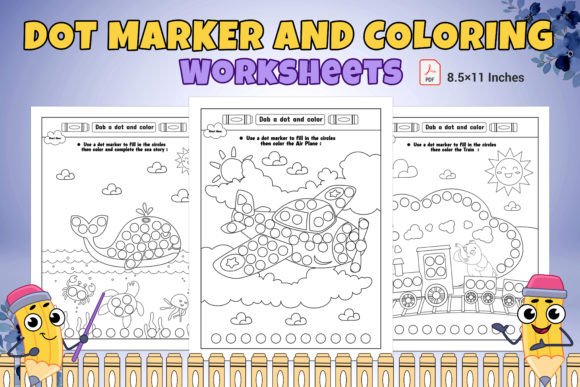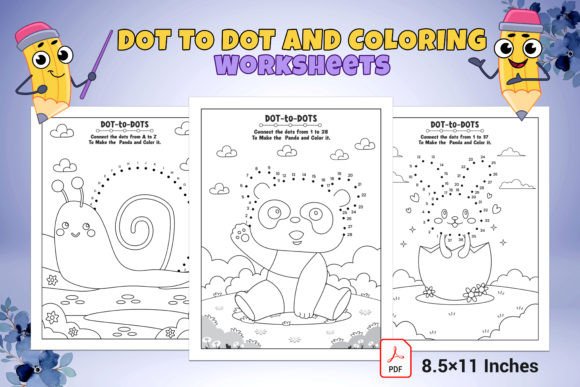
Dot to Dot and Coloring Worksheets
Dot to dot and coloring worksheets are more than quiet-time fillers—they’re precision tools for early childhood development, classroom engagement, and creative entrepreneurship. Designed with intention, these activities support the foundational growth of fine motor control, hand-eye coordination, number recognition, and visual tracking—all while feeling like play to a preschooler or kindergartener. What makes them especially valuable today is their adaptability: they work equally well on a classroom whiteboard, as printable take-home packets, or as polished interiors for Amazon KDP books.
A Dual-Purpose Learning Engine
At first glance, dot to dot seems simple—connect numbered points in sequence to reveal a shape. But beneath that simplicity lies layered cognitive scaffolding. Children practice counting, sequencing, focus, and spatial reasoning as they move from point to point. Coloring adds another dimension: color choice, boundary awareness, pressure control, and sustained attention. Together, these two actions form a low-pressure, high-impact routine that builds neural pathways without requiring verbal instruction or screen time.
For educators, this means fewer behavior-management moments and more observable skill progression. A child who struggles to hold a pencil steadily may gain confidence after three weeks of consistent dot-to-dot tracing—each page reinforcing grip strength and wrist stability. For parents, it’s a tangible way to support school-readiness at home, especially when paired with conversation (“What animal did you uncover? How many legs does it have?”).
Creative Flexibility Across Contexts
These worksheets aren’t locked into one use case—and that’s where their real value emerges. A freelance illustrator might adapt the line work into themed seasonal series (e.g., “Spring Garden Dot-to-Dot + Coloring” or “Ocean Friends Counting & Color”). A homeschooling parent can integrate them into unit studies: pair a dinosaur-themed worksheet with a short nonfiction read-aloud, then discuss size, habitat, or extinction. A small publisher building a KDP catalog can bundle them by developmental focus—“Fine Motor First Steps,” “Counting to 20,” or “Animals Around the World”—ensuring each book serves a clear audience need.
Designers working on interiors should prioritize clarity over decoration: clean numbering, generous spacing between dots, and bold outlines post-reveal. Avoid overly intricate silhouettes for early learners—start with recognizable shapes (a smiling sun, a friendly fox, a simple rocket) before introducing multi-part objects. Consistency matters too: keep font size uniform across pages, maintain the same dot style (circles, not stars or squares), and align all illustrations to the same baseline so printed books feel cohesive.
Real-World Applications Beyond the Page
In the classroom, dot to dot and coloring worksheets function as versatile teaching materials. Use them as:
- Transition tools—hand out during arrival time or after circle time to settle energy;
- Differentiated practice—offer versions with numbers 1–10, 1–15, or skip-counting by 2s to match individual readiness;
- Assessment aids—observe how a child navigates lines, whether they count aloud, and if they self-correct errors;
- Collaborative extensions—after completing a worksheet, ask students to name three colors they used or describe what their picture “does” (“My dragon breathes rainbows!”).
For creators building digital products, consider layering interactivity: add QR codes linking to audio number chants, or embed printable certificates (“I Mastered My First Dot-to-Dot!”). If designing for KDP, remember Amazon’s file requirements—8.5″ x 11″ dimensions, no bleed, CMYK-safe black-and-white interiors—and always test print a physical copy before final upload. Real-world testing catches subtle issues: faint dots, cramped margins, or inconsistent line weights that look fine on screen but fail under printer resolution.
Why These Worksheets Stand Out
Not all dot to dot and coloring worksheets deliver equal value. The most effective ones balance structure with openness—offering enough guidance to build competence, yet enough blank space to invite personal expression. That’s why unique artistic designs matter: a stylized owl with textured feathers invites different coloring choices than a cartoon-style owl with flat shapes. It’s not about complexity—it’s about resonance.
High-resolution interiors ensure crisp lines even at 200% zoom, critical for children who trace slowly or press heavily. White paper backgrounds reduce visual clutter and support accessibility for learners sensitive to contrast. And because these are ready-to-upload PDFs, creators skip hours of formatting—no wrestling with margins, no guessing at DPI settings. You get eight thoughtfully paced pages: varied themes (dinosaurs, nature, transportation, community helpers), progressive difficulty, and consistent layout logic.
Practical Tips for Maximum Impact
If you're using these in your own work—whether teaching, publishing, or designing—keep these principles in mind:
- Start small. Introduce one new theme per week. Let children revisit favorites to reinforce mastery—not just novelty.
- Pair with movement. After finishing a worksheet, act out the subject: hop like a frog, stomp like a T. rex, or “fly” like a rocket. Kinesthetic reinforcement deepens learning.
- Respect process over product. Praise effort (“I saw you take your time on dot 14”) more than outcome (“That’s the best dragon ever!”). This nurtures growth mindset.
- Reuse intentionally. Laminate high-use pages for dry-erase tracing; cut completed sheets into puzzles; or punch holes and bind into a “My First Workbook” keepsake.
Dot to dot and coloring worksheets succeed when they meet both developmental needs and practical realities—whether that’s fitting seamlessly into a busy teacher’s lesson plan, supporting a parent’s desire for meaningful screen-free time, or giving a KDP creator a reliable, tested interior that converts. They don’t promise miracles—but they do deliver steady, measurable progress, one connected dot at a time.