KDP Template for Journals
If you're building low-content books for Amazon KDP—or designing print-ready journals, planners, or trackers at home—you need reliable, flexible, and production-ready assets. That’s where a KDP Template for Journals stands out: not just another generic layout, but a purpose-built foundation engineered for real-world publishing and personal use.
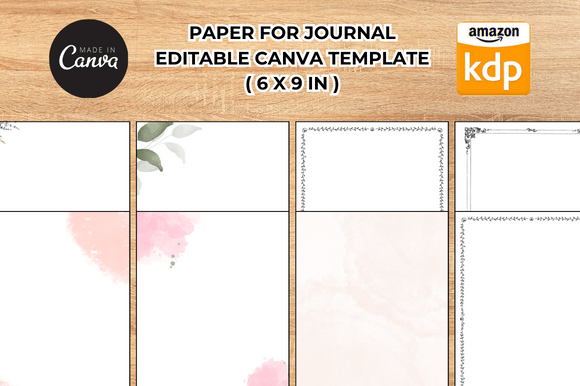
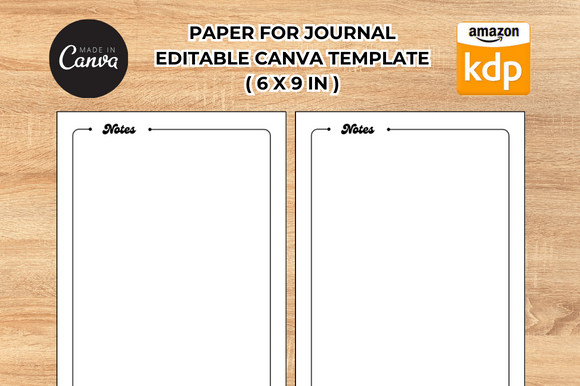
This isn’t about flashy graphics or overdesigned pages. It’s about clean structure, precise dimensions (6×9 inches—the most popular trim size for paperback journals), and seamless compatibility with both home printing and professional KDP upload workflows. What you get is practical: one high-resolution PNG of the interior paper design and one editable PDF linked directly to Canva. That means no wrestling with layered PSD files or complex software—just open, customize, and export.
Why This Format Works So Well for Low-Content Creators
A KDP Template for Journals bridges two critical needs: speed and control. You’re not starting from blank canvas stress. You’re stepping into a proven framework—lined, dotted, grid, or blank—that already respects KDP’s bleed, margin, and resolution requirements. The 300 DPI PNG ensures crisp text and subtle line work when printed, while the Canva-linked PDF lets you adjust fonts, add headers, insert logos, or tweak spacing in minutes—not hours.
It’s especially valuable if you’re juggling multiple formats: a weekly planner for clients, a habit tracker for your newsletter audience, or a minimalist notebook series for Etsy. With one consistent template, you maintain visual cohesion across products while saving dozens of hours on layout tweaks per title.
Real Uses Beyond “Just a Journal”
Don’t limit this to diary-style books. A KDP Template for Journals scales elegantly across functions:
- Business & Operations: Inventory log books, client intake sheets, service checklists, or daily standup trackers—printed in-house or sold as branded tools.
- Education & Coaching: Student reflection journals, lesson planning pads, behavior tracking sheets, or curriculum-aligned note templates for teachers.
- Creative Practice: Sketchbook interiors with light grid overlays, poetry notebooks with generous margins, or recipe logs designed for handwritten notes and ingredient cross-outs.
- Digital Integration: Pair the printable version with Notion or Obsidian using the same layout logic—so your analog and digital systems feel like parts of one workflow.
- Branded Publishing: Freelancers and agencies embed their logo, color accents, or custom headers directly in Canva—then publish under their imprint without licensing headaches.
One creator I worked with used this exact template to launch a series of “Quiet Work” planners—minimalist daily pages with soft line weight and intentional white space. She added her signature serif font in Canva, exported as PDF, uploaded to KDP in under 12 minutes, and had her first sale before lunch. No designer, no plugin, no trial-and-error formatting.
What Makes This More Than Just “Another Printable”
Three things set a thoughtful KDP Template for Journals apart:
- Print-Ready Precision: Margins are calibrated for KDP’s 0.125" inner margin requirement. No text gets trimmed. No lines vanish near the spine. The 6×9" ratio fits standard paperback bindings without awkward scaling.
- True Editability: The Canva link isn’t a static preview—it’s a live, editable document. Change line height, adjust dot spacing, add checkboxes, or switch from ruled to Cornell-style layouts—all within a browser.
- Neutral but Intentional Design: Black-and-white, no watermarks, no forced branding. It’s yours to adapt—not a theme that fights your voice. Whether you're building a clinical patient journal or a whimsical bullet journal starter, the base stays invisible so your content shines.
Smart Ways to Use It—Without Overcomplicating Things
You don’t need to be a Canva power user. Start small:
- Add your name or brand initials to the bottom corner of each page—takes 45 seconds in Canva, adds instant ownership.
- Use the PNG as-is for quick home printing: load it into Word or Google Docs, set page size to 6×9", and print double-sided on 24–28 lb paper for a sturdy notebook feel.
- Create variations fast: duplicate the Canva file, change line weight for a “light writing” version, then a “bold outlining” version for sketching—same structure, different function.
- For educators or coaches: insert a QR code linking to a free video tutorial or downloadable resource—right on the first page of the journal interior.
And if you’re evaluating whether this fits your workflow? Ask yourself: Do I spend more than 20 minutes formatting one interior? Do I reuse similar layouts across multiple titles? Do I want full control—but not full software overhead? If yes, this isn’t convenience. It’s leverage.
Things to Keep in Mind Before You Begin
A KDP Template for Journals simplifies production—but doesn’t eliminate all decisions. Here’s what still matters:
- Font Licensing: If you swap in a custom font via Canva, confirm it’s licensed for commercial use—especially if selling the final book. Stick with Canva’s default “Free for Commercial Use” fonts unless you’ve verified rights.
- Page Count Rules: KDP requires multiples of 24 pages for perfect-bound paperbacks. Build your final file to hit 96, 120, or 144 pages—not 100 or 117—to avoid padding or trimming surprises.
- Test Print First: Even with perfect specs, printer calibration varies. Run one physical copy before bulk printing or final KDP upload—check alignment, contrast, and spine gutter clearance.
- Interior Consistency: If mixing page types (e.g., monthly calendar + daily log), ensure line weights and spacing match visually. Small mismatches become glaring across 100+ pages.
Finally—don’t chase “more features.” A great KDP Template for Journals earns its value through restraint: clarity over clutter, flexibility over flash, and quiet reliability over novelty. It’s the kind of tool that fades into the background… until you realize how much smoother everything runs because it’s there.