Math and Number Tracing Workbook: A Practical Tool for Real Learning Moments
Imagine a quiet morning in your preschool classroom—children seated at low tables, crayons in hand, carefully following dotted lines that form the number 7. One child giggles as her pencil slips, then tries again. Another proudly holds up his page, pointing to where he traced 3 six times—and got every loop just right. This isn’t just busywork. It’s the Math and Number Tracing Workbook in action: 10 thoughtfully designed pages that turn early numeracy into tactile, joyful practice.
What This Workbook Actually Does (Beyond “Tracing Numbers”)
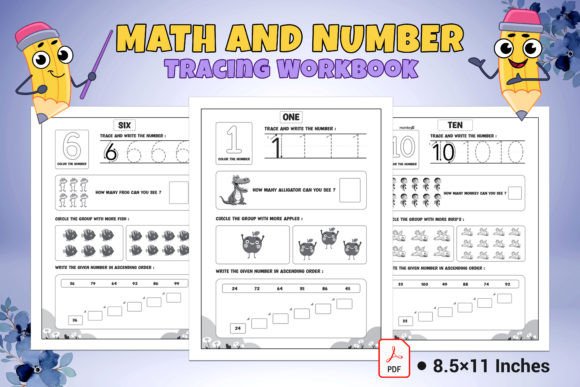
The Math and Number Tracing Workbook isn’t a flashcard deck or a digital app—it’s a physical, screen-free experience built around how young children learn best: through repetition, touch, and visual scaffolding. Each of the numbers 1–10 appears on its own page with three key elements: a large, bold numeral to trace, a smaller version for independent writing practice, and a themed illustration (like a friendly T-Rex counting eggs or a rocket launching at “5”) that grounds the number in meaning—not abstraction.
That distinction matters. When a 4-year-old traces 4 while counting four stars beside it, they’re not just copying shapes. They’re linking symbol to quantity, hand movement to cognitive recall, and focus to fine motor control—all in one fluid motion.
Where This Workbook Fits Into Real Life (Not Just “School”)
Teachers use the Math and Number Tracing Workbook during small-group rotations—especially with children who need extra time to build pencil grip or number recognition. But its usefulness stretches far beyond the classroom:
- At-home learning: Parents juggling remote kindergarten prep or supplementing public school curriculum find these pages refreshingly simple—no setup, no login, no battery charge. Just print, grab a pencil, and go. One mom shared how she laminates the sheets and uses dry-erase markers so her twins can reuse them daily during breakfast “learning time.”
- Homeschool co-ops: Leaders appreciate the clean 8.5″ x 11″ layout—it prints perfectly on standard home printers, fits neatly into binders, and pairs easily with hands-on tools like playdough number molds or counting bears.
- Therapy settings: Occupational therapists use the workbook’s consistent line weight and generous spacing to support children working on hand strength, crossing the midline, or visual-motor integration—without needing to design materials from scratch.
- KDP creators: For those building printable libraries or launching starter activity bundles, this workbook is production-ready: high-resolution black-and-white interiors, KDP-tested margins, no bleed, and original artistic themes that stand out in a crowded “preschool math” niche.
Who Benefits—and How Their Needs Shape Use
A pre-K teacher in a Title I school might use the Math and Number Tracing Workbook as part of a “number of the week” routine—displaying the illustrated page on the wall, tracing it together as a group, then sending a copy home in a take-home folder. The consistency helps families without educational resources participate confidently.
A Montessori guide may cut out the number illustrations and pair them with sandpaper numerals or wooden counters—using the workbook as a bridge between sensorial exploration and symbolic representation.
A grandparent helping care for a toddler after school might sit side-by-side, tracing slowly while saying each number aloud—turning it into bonding time *and* brain-building time, without pressure or performance.
Practical Considerations Before You Print or Purchase
Because it’s designed for real-world use—not just aesthetics—the Math and Number Tracing Workbook includes intentional choices you’ll notice the moment you open the file:
- No bleed means no guessing: What you see on screen is exactly what prints—no critical parts of the number or illustration get chopped off at the edge. That reliability saves time when printing batches for a class.
- Black-and-white interior isn’t a limitation—it’s a feature: It keeps printing costs low, supports accessibility (high contrast for emerging vision), and invites creativity (kids love coloring the T-Rex after tracing!)
- White paper specification matters: Unlike some workbooks printed on off-white or recycled stock, this uses bright white paper—making pencil lines pop and reducing eye strain during longer practice sessions.
- It’s focused—not exhaustive: This is a 1–10 tracing foundation, not a full-year curriculum. It excels at its purpose: building confidence, control, and number familiarity. If you need addition drills or skip-counting, this isn’t the tool—but that clarity is precisely why it works so well for its intended audience.
Strengths That Show Up in Daily Use
What makes the Math and Number Tracing Workbook more than just another PDF? Three things parents and educators consistently mention:
- It grows with the child: Early on, a child may only trace the large number with help. By week three, they’re attempting the smaller version independently. By month two, they’re adding their own tally marks or drawing objects to match the numeral. The simplicity creates space for organic progression.
- It reduces decision fatigue: No lesson planning required. No “what do I do next?” panic. Open the file, print, and meet the child where they are—whether that’s practicing grip, reinforcing sequence, or simply enjoying the satisfaction of a completed page.
- It invites participation—not correction: Because the illustrations are warm and playful (not cartoonish or overly complex), adults naturally lean in with curiosity instead of critique. “How many eggs do you think the T-Rex counted?” feels different—and more supportive—than “Is this 6 written correctly?”
A Resource That Respects Time, Energy, and Development
We don’t need more complicated tools. We need ones that work quietly, reliably, and respectfully—meeting little hands where they are, honoring short attention spans, and fitting seamlessly into already-full days. The Math and Number Tracing Workbook does exactly that: no gimmicks, no filler, no hidden learning objectives. Just clear lines, meaningful numbers, and room for growth—one traced digit at a time.