Valentine’s Day Dot Markers for Kids
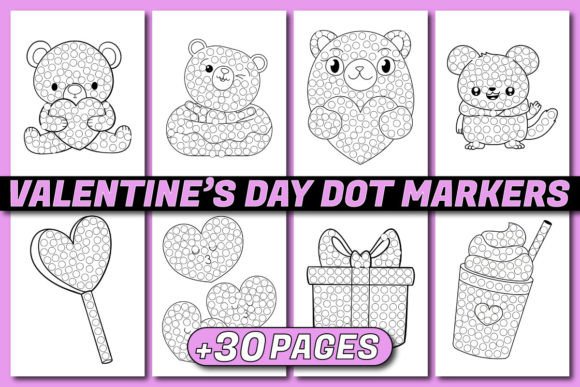
Valentine’s Day dot markers for kids aren’t just another coloring page—they’re a tactile, joyful entry point into early learning, fine motor development, and creative expression. Designed with intention, these dot marker activities combine the simplicity of pressing a marker onto paper with the thematic charm of hearts, cupcakes, love bugs, and kawaii-style characters—making them ideal for preschoolers, kindergarteners, and early elementary learners.
What sets this resource apart is its dual-purpose design: it’s both a ready-to-use activity book and a flexible creative toolkit. The Valentines Dot Markers Activity Book for Kids (30 pages, PDF/JPG/PNG) delivers clean, high-contrast outlines optimized for dot marker use—no bleeding, no frustration, just satisfying pops of color where little fingers land. But more importantly, it’s built to scale: from quiet classroom centers to homeschool routines, party favors to therapeutic play, or even as a low-prep sensory warm-up before handwriting practice.
Creative Possibilities Beyond the Page
Dot markers invite open-ended exploration—not just “coloring in,” but pattern-making, counting, sorting, and storytelling. A single heart outline can become:
- A counting exercise: “Place five red dots on each petal”;
- A color-matching game: “Use only pink and purple to fill the cupcake”;
- A pre-writing warm-up: “Dots along the dotted line help your hand learn how to draw curves”;
- A collaborative mural: Print multiple copies, let each child complete one element, then assemble a class “Love Wall.”
For creators publishing on KDP, the interior files are intentionally versatile. The black-and-white line art is crisp at 300 DPI, fully editable in design software, and formatted for standard 8.5" x 11" trim. That means you can easily adapt pages for themed bundles—swap in glitter accents for a “Sparkle & Love” edition, add tracing guides for a fine-motor upgrade, or layer in simple sight words (“love,” “friend,” “heart”) to support emergent literacy.
Real Uses Across Real Contexts
Educators use Valentine’s Day dot markers for more than holiday fun. In inclusive classrooms, they serve as accessible tools for children with varying motor skills—no need to grip a pencil tightly; just press and release. Occupational therapists integrate them into sensory diets, pairing dotting with deep pressure input or rhythmic breathing prompts (“One breath in, one dot down”).
Small business owners and makers repurpose the files creatively: turn completed pages into custom greeting cards (scan and print on cardstock), cut out decorated shapes for felt board storytelling, or laminate sheets for dry-erase reuse in waiting rooms or daycare centers. One freelance illustrator used the base illustrations as templates for a series of animated social media stickers—adding subtle bounce and blush effects to the kawaii characters for a playful Valentine’s campaign.
Bloggers and parenting influencers embed printable pages directly into seasonal roundups (“10 Screen-Free Valentine Activities”), linking to the full activity book as a natural next step. Because the content is age-specific and pedagogically grounded—not just decorative—it earns trust and repeat engagement.
Design Choices That Support Clarity and Consistency
The strongest Valentines dot markers activity books share three quiet but critical traits: intentional spacing, visual hierarchy, and repetition with variation. This version uses generous white space around each design—reducing visual overwhelm for young eyes. Outlines are bold (2.5 pt minimum), with clear entry points (e.g., a starting dot on the left side of a heart) to guide directionality. And while all 30 pages follow the same core aesthetic—kawaii-inspired, friendly, uncluttered—the motifs rotate meaningfully: animals holding hearts, friendship bracelets, candy hearts with letters, and abstract patterns like polka-dot swirls.
That consistency isn’t about sameness—it’s about building recognition and confidence. When a child sees the third “love bug” page, they know how to begin, where to pause, and how to interpret the shape—even if the bug now wears sunglasses or carries a tiny gift box. That predictability supports focus, reduces frustration, and makes independent use possible long before adult supervision ends.
Practical Tips for Creators, Educators, and Parents
If you’re adapting or using this resource, start small—and stay specific. Instead of “do the whole book,” try:
- One focused skill per session: Today = counting dots (1–10). Tomorrow = matching colors to emotion words (“Red = excited,” “Pink = happy”).
- Pair with real materials: Use actual dot markers (not just crayons), and keep a tray nearby for easy cleanup. Add textured paper or sticker dots for multi-sensory extension.
- Document growth: Snap photos of early attempts vs. later ones—not for comparison, but to notice progress in hand control, color awareness, or sustained attention.
For KDP publishers: test-print at least three pages on your target paper stock before finalizing. Dot marker lines must remain crisp after printing—faint or broken outlines undermine usability. Also, include a brief, illustrated “How to Use” page inside the book (not just in the description). Parents and teachers appreciate clarity over cleverness.
Why This Format Endures
Dot marker activity books succeed because they meet children where they are—not as miniature adults expected to color neatly within lines, but as curious, kinetic learners who explore the world through touch, rhythm, and repetition. Valentine’s Day dot markers for kids transform abstract concepts like “kindness” or “friendship” into something tangible: a red dot placed beside a smiling face, a trail of hearts leading from one friend to another, a heart-shaped frame filled with fingerprints instead of ink.
And for the adults guiding that process—whether designing a product, planning a lesson, or choosing an afternoon activity—the value lies in reliability. It works without screens. It scales across ages and abilities. It leaves room for interpretation, not just instruction. It’s cheerful without being cloying, structured without being rigid, and purposeful without losing its playfulness.
That balance—between intention and openness, simplicity and depth—is why Valentine’s Day dot markers for kids continue to resonate across classrooms, living rooms, and creative studios alike.